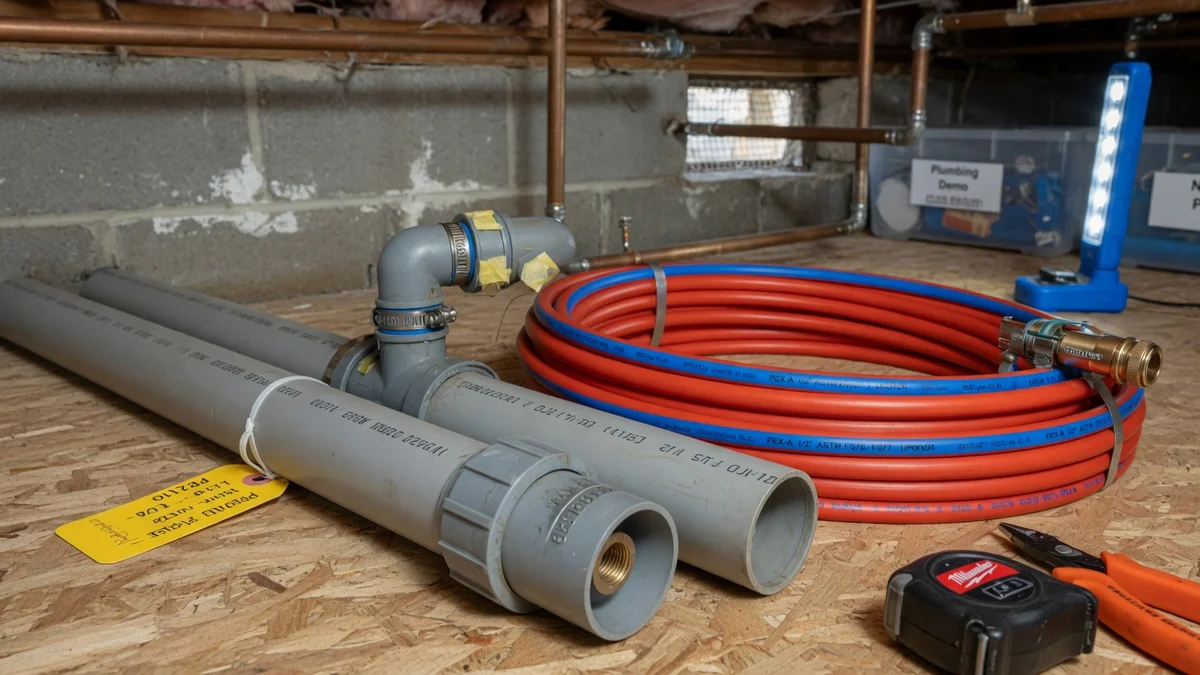
Here's how to identify it — and why it matters more in Nashville than most markets.
What Is Polybutylene Pipe?
Polybutylene (PB, PB2110) is a gray or blue-gray plastic pipe that was widely installed in residential construction from approximately 1978 to 1995. It was cheap, easy to install, and initially marketed as the future of residential plumbing. It failed catastrophically across the United States due to reactions with oxidants in municipal water supplies (primarily chlorine), causing the pipe to become brittle and fail at fittings or in the pipe body itself.
A class-action settlement (Cox v. Shell Oil) was reached in 1995, and the material was pulled from production. But millions of homes were built with it — including a significant concentration in Nashville's 1980s and early 1990s suburban subdivisions.
Visual Identification
The pipe itself is the easiest starting point:
The fittings are an equally reliable identifier — and often easier to spot than the pipe itself:
Where to look in a Nashville flip acquisition:
Why Nashville Properties Are Higher Risk
Nashville's 1980s and 1990s suburban construction boom coincides exactly with the peak polybutylene installation era. The high-volume subdivisions in Antioch, Madison, Smyrna, Murfreesboro, Spring Hill, and Brentwood built during this period have a disproportionate rate of poly installations.
Davidson County also has moderately chlorinated water — more than enough to accelerate PB degradation. Properties in areas served by Metro Nashville Water Services that were built between 1978 and 1995 should be treated as poly suspects until confirmed otherwise.
The Inspection Gap
A standard home inspection rarely catches all polybutylene installations. Inspectors are typically looking at visible plumbing, and poly in walls, attics, and under slab is invisible without destructive investigation. A sewer camera covers the DWV side — it won't show you supply lines.
For reliable identification:
Why Spot Repair Is Never the Right Answer
This is the decision that costs investors the most money. A seller's agent will often propose "spot repairing" the visible problem areas — replacing only the fittings that have failed or the sections that are already leaking. This is the wrong answer for two reasons:
Disclosure. Once poly is identified and documented during the transaction, it has to be disclosed to future buyers. No amount of spot repair changes that disclosure requirement. A buyer's inspector will still flag poly anywhere in the house. Lenders increasingly flag poly as a material defect. The disclosure problem doesn't go away with a partial fix.
The failure pattern. Polybutylene doesn't fail all at once. It fails progressively at fittings and stressed sections over years. Fixing three failed spots doesn't address the 47 other connections in the house that are in various stages of degradation. You'll be back with a leak repair call within 12–24 months — plus you still have a poly disclosure.
The right answer is full PEX-A replacement. In the Nashville market, a full repipe is typically $4,500–$14,000 depending on property size, construction type, and whether walls are already open. That cost — budgeted in at acquisition — is far less than the negotiation concessions poly will trigger at listing, or the emergency repair costs after closing.
Using Poly as a Negotiation Tool
If you identify poly during due diligence, you have leverage — use it correctly: 1. Get a written repipe estimate from a licensed Nashville plumber before removing your contingency 2. Use the estimate (not a guess) as the basis for a price reduction request or credit 3. Negotiate a flat credit equal to the repipe cost, not a partial amount. A partial fix creates liability and doesn't solve the disclosure problem. 4. If the seller won't negotiate, factor the full repipe into your acquisition model — or walk.
Identifying poly before closing is the difference between a manageable line item and a deal-killing surprise. Call (734) 748-4831 to schedule a pre-acquisition plumbing assessment on your next Nashville acquisition.
Questions About Your Nashville Project?
Luke Lays Pipe provides flat-rate plumbing for Nashville house flips and investors — repiping, sewer repair, water heaters, and more.
Get a Free Quote
Flat-rate pricing for Nashville flips and investors.
(734) 748-4831 Send a Quote RequestInvestor Tool
Flip Plumbing Cost Calculator
Estimate repiping, sewer, water heater, and permit costs before you make an offer — built for Nashville investors.
Estimate My Budget →