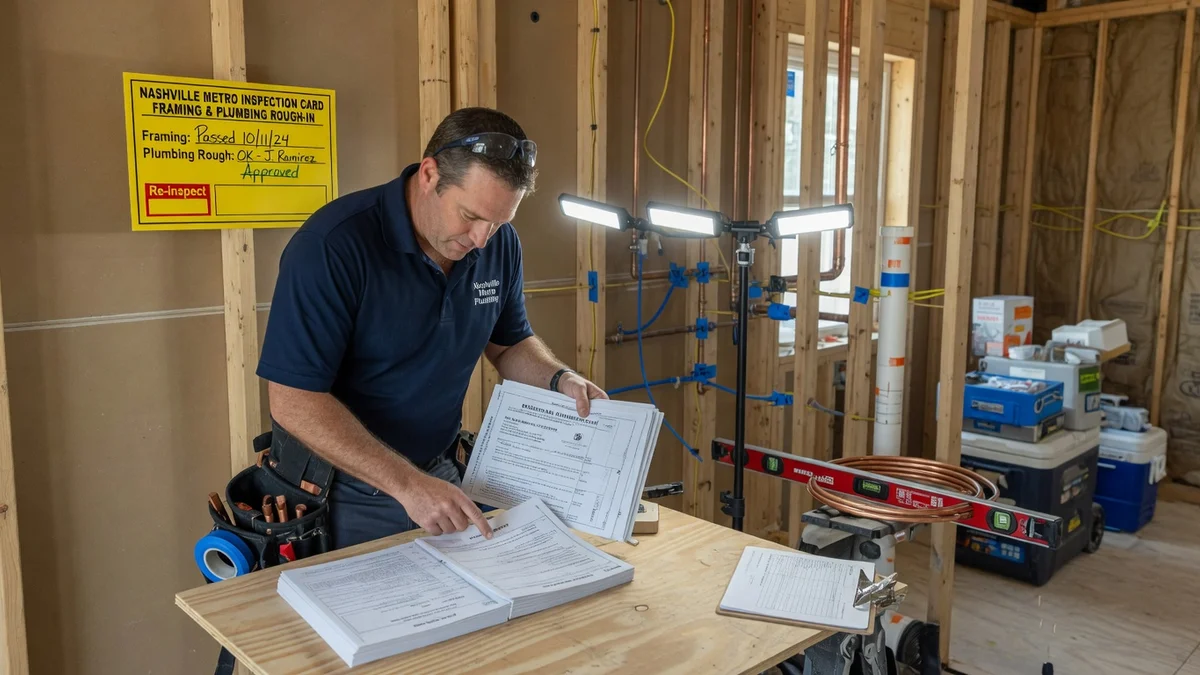
Unpermitted plumbing work is the fastest way to create disclosure liability on a Nashville flip. Here's exactly what requires a permit in Metro Nashville and surrounding counties, what turnaround looks like in 2026, and why permits are a margin-protection strategy rather than a bureaucratic inconvenience.
What Always Requires a Permit in Metro Nashville
Under the International Plumbing Code (IPC) as adopted by Metro Nashville with local amendments, the following plumbing work always requires a permit and inspection:
Supply side:
Whole-house repiping (any material change) New water service installation Water heater replacement (yes, including like-for-like tank replacement) Pressure-reducing valve (PRV) installation Water softener installation with new connections Any new supply line that extends beyond the fixture itselfDrain, waste, and vent (DWV):
Sewer line repair or replacement (any work at or below grade) New cleanout installation New drain configurations (kitchen island sinks, bathroom additions) Any work to the main stack or vent system Under-slab work of any kindNew fixtures in new locations:
Moving a sink, toilet, or shower to a new floor plan position always requires permits for the rough-in and possibly the structural modifications that enable itWhat typically does NOT require a permit:
Like-for-like fixture replacement (replacing a toilet with another toilet in the same location, replacing a faucet) Unclogging drains (no pipe modification) Replacing a supply stop valve at an existing fixtureWhen in doubt, pull the permit. The cost of a permit ($150–$400 for most residential plumbing) is trivially small compared to the disclosure liability of unpermitted work.
Permit Turnaround by Jurisdiction (2026)
Metro Nashville / Davidson County:
The Metro Nashville Codes Administration handles permit applications online through the Nashville Permits portal. For standard residential plumbing:
Digital plan review: 5–10 business days for permits not requiring plan review With plan review (new construction, additions): 10–20 business days Expedited review: Available for residential projects for an additional fee, typically reduces turnaround by 30–50% Inspection scheduling: 2–5 business days after permit issuance; inspections can be scheduled onlineWilliamson County (Brentwood, Franklin, Spring Hill):
Franklin: 5–10 business days standard, permit office is responsive to contractor relationships Brentwood (City of Brentwood): 5–7 business days for standard residential, efficient online portal Spring Hill: Permit through City of Spring Hill, 5–10 business days; split jurisdiction (partly Maury County) can complicate some addressesRutherford County (Murfreesboro, Smyrna, La Vergne):
Murfreesboro: 7–14 business days; City of Murfreesboro handles city limits, Rutherford County handles unincorporated areas Smyrna: 5–10 business days through Town of SmyrnaSumner County (Hendersonville, Gallatin):
Hendersonville: 7–14 business days through City of Hendersonville Note: Water heater permits in Sumner County require a licensed plumber of record on the permitThe Right Way to Schedule Permits on a Flip
Permitting is the most common source of schedule slippage on Nashville flips. The mistake is applying for permits after demo instead of at or near acquisition.
Optimized permit timeline:
1.
At or within 2 weeks of closing: Submit permit applications for all plumbing scope identified during due diligence. You don't need to have a GC under contract to apply — you need a licensed plumber of record. 2.
Permit issuance (5–10 business days): Permits in hand before framing is complete. 3.
Rough-in inspection: Scheduled during framing, before insulation and drywall. This is the only inspection that requires an open ceiling/wall. 4.
Final inspection: After fixtures are installed, before final finishes.
The single biggest mistake: scheduling the plumber after framing is done, then waiting on permits while the project is sitting idle. For a typical Nashville flip, this adds 2–4 weeks to the timeline with no value creation.
Water Heater Permits: The Most Commonly Skipped
Water heater replacement is the most frequently unpermitted plumbing job on Nashville flips. Subcontractors often install without a permit because many homeowners and investors don't know it's required. In Metro Nashville, water heater installation requires:
A plumbing permit Inspection of the installation (typically same-day or next-day availability) Compliant installation per current IPC: proper TPR valve, discharge piping to floor drain or exterior, seismic strapping in applicable zones, proper gas piping if gas unitThe penalty for an unpermitted water heater isn't always caught at listing — but when a sharp buyer's inspector asks for the permit card and it doesn't exist, the conversation becomes uncomfortable fast. We pull the permit on every water heater we install. It's a 30-minute inspection, not a project stopper.
What Unpermitted Work Does to Your Resale
When unpermitted work is disclosed (and it must be), buyers' agents use it as leverage in two ways:
1.
Price reduction: A buyer can legitimately request a credit equal to the cost of obtaining retroactive permits (which requires exposing and re-inspecting the work) plus any required remediation. 2.
Lender issues: Conventional lenders and FHA/VA lenders increasingly flag unpermitted work as a material condition. If the appraiser notes it, you may lose the buyer entirely.
Retroactive permitting is not always available. Metro Nashville may require walls to be opened to inspect rough-in work that was covered without inspection. The cost of opening walls, having the inspection, and patching can easily exceed $5,000–$15,000 for a full repipe — on top of the original repipe cost.
Pull the permits at acquisition. The turnaround is predictable, the cost is minimal, and the protection is complete.
Call (734) 748-4831 to discuss permit strategy on your next Nashville project. We handle all permit applications as part of our flat-rate quotes.