Why Nashville Has Higher-Than-Average Sewer Risk
Nashville's combination of clay soils and aging housing stock creates a specific sewer vulnerability that out-of-state investors often underestimate.
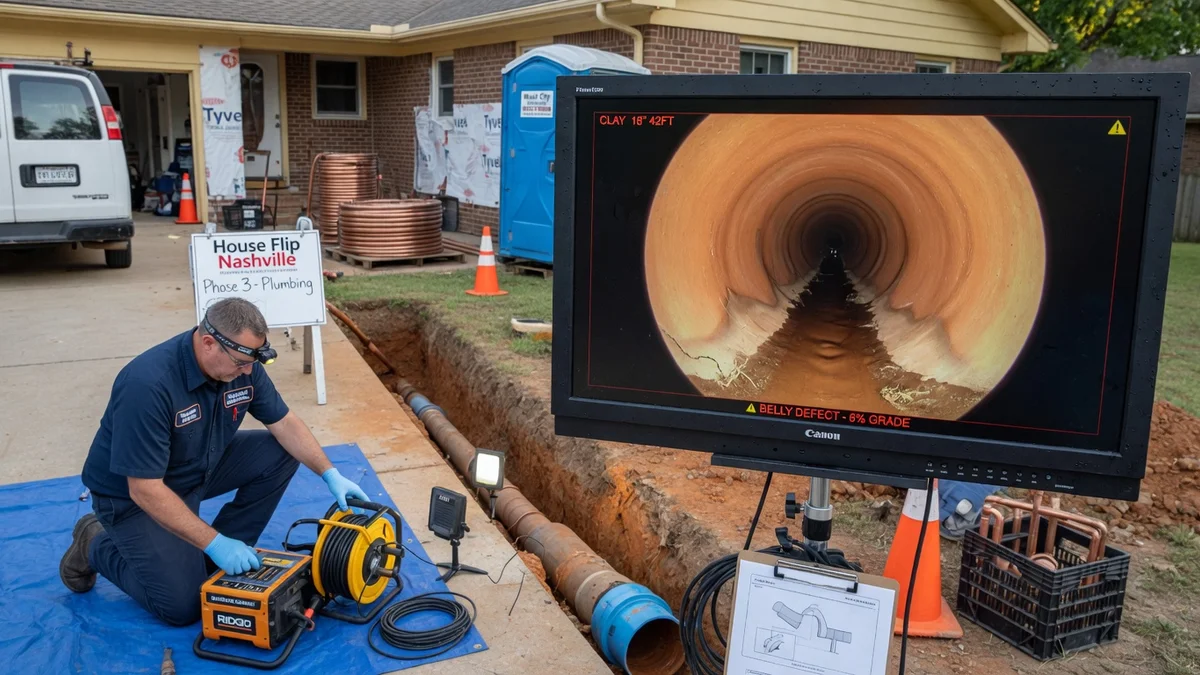
Davidson County clay soils (Maury and Dickson series) expand when wet and contract when dry. This continuous movement — amplified by Nashville's temperature swings — causes lateral sewer lines to shift and sag over decades. The result: pipe bellies — low spots in the sewer lateral where the line dips below the ideal slope (1/4 inch per foot). Solids accumulate in these bellies and cause backups, root infiltration, and eventual collapse.
Pre-1980 Nashville homes predominantly have cast iron or clay tile lateral sewer lines. Both deteriorate with age, root intrusion, and soil movement. Cast iron corrodes internally (reducing diameter) and fails at hub-and-spigot joints. Clay tile is porous, attracts roots, and cracks under soil pressure. Neither material was designed for 50+ years of service in active clay soil conditions.
The failure rate we see on camera inspections in East Nashville, Antioch, Madison, and other high-inventory areas is striking: we find camera issues — pipe bellies, root intrusion, separation, or corrosion — on 60–75% of properties built before 1985. That's not a marginal risk. That's a near-certainty requiring assessment.
When You Always Need a Camera Inspection
Any property built before 1990 in Nashville proper and Davidson County.
Any property in these specific zip codes regardless of age: 37115 (Madison), 37211, 37217, 37218 (Antioch/Southeast Nashville), 37206 (East Nashville), 37207 (North Nashville). These are high-incidence areas based on our inspection data.
Any property with a history of slow drains or sewer backup. These symptoms often appear on seller disclosure forms. A camera will tell you whether the issue is a minor obstruction or a structural failure.
Any property where you're planning significant plumbing work. If you're repiping, adding a bathroom, or running new drain lines, you need to know the condition of the lateral before you pull permits and schedule work. Discovering a collapsed sewer line after you've already started renovation is the worst possible time.
What the Camera Finds
A sewer camera inspection runs a small HD camera through the main lateral from the cleanout (or a pulled toilet) to the city connection. The camera is recorded and the technician marks the location and depth of each finding. What we look for:
Pipe bellies (the most common Nashville finding): A belly is a low spot where the pipe has sagged below proper grade. Severity is graded — a minor belly may drain adequately for years; a significant belly with standing water requires correction. Belly correction can be done by spot-excavation (localized repair) or full lateral replacement depending on length and depth.
Root intrusion: Tree roots enter through joints and cracks, progressively blocking the line. Detected early, root intrusion can be treated with hydro jetting and a root-killing treatment. Advanced root intrusion requires pipe replacement.
Joint separation: Cast iron and clay tile lines connected at hub-and-spigot joints. Soil movement separates these joints, creating gaps where solids catch and roots enter. Small separations can be relined; significant separation requires replacement.
Corrosion and scaling (cast iron): Cast iron corrodes internally, depositing iron oxide and reducing the effective pipe diameter. Heavy scaling that reduces diameter by 30%+ typically requires replacement; lighter scaling can be treated with hydro jetting.
Offset / misalignment: When joints shift laterally rather than vertically, the resulting step in the pipe collects debris and restricts flow. Correction requires excavation.
Pipe material identification: The camera will confirm whether the lateral is clay tile, cast iron, ABS, PVC, or Orangeburg (a fiber-resin material used briefly in the 1940s–1960s that fails entirely as it ages). Orangeburg is occasionally found in older Nashville properties and is always a replacement.
Understanding Your Report
A good camera report gives you:
What the report doesn't tell you: the cost to fix it. That requires a separate estimate from a plumber or excavation contractor who can review the footage and site conditions.
How to Use Camera Findings in Acquisition Negotiations
A camera finding is a documented, quantifiable defect. Use it correctly:
Before removing your inspection contingency: Get a repair estimate from a licensed Nashville plumber based on the camera footage. Not a ballpark — a written estimate.
Price reduction vs. credit: A price reduction is cleaner than a credit on most Nashville transactions. A credit still closes at the original price (which may affect your financing); a price reduction changes the acquisition basis. Discuss with your agent which structure gives you better flexibility.
What to ask for: The full cost of correction, not a partial fix. A 6-foot belly repair doesn't address the 4-foot belly 12 feet further down the line. If the camera shows multiple issues, quote the full scope.
When to walk: If the lateral is collapsed, the depth is extreme (over 8 feet), or the footage shows full-pipe deterioration across the majority of the run, the repair cost can exceed $15,000–$30,000. That's a line-item that changes your acquisition model entirely. Walk if the seller won't adjust.
Cost Ranges for Nashville Sewer Corrections (2026)
These ranges vary significantly with depth, access, soil conditions, and whether concrete or landscaping needs to be removed and restored. The camera inspection is the prerequisite to any of these estimates.
The Right Time to Schedule
Pre-acquisition — during your inspection contingency period. A sewer camera takes 45–90 minutes and the report should be available same-day or next-day. Schedule it alongside (not instead of) the general home inspection.
Call (734) 748-4831 to schedule a sewer camera inspection on your next Nashville acquisition. We provide written reports suitable for negotiation and permit documentation.
Questions About Your Nashville Project?
Luke Lays Pipe provides flat-rate plumbing for Nashville house flips and investors — repiping, sewer repair, water heaters, and more.
Get a Free Quote
Flat-rate pricing for Nashville flips and investors.
(734) 748-4831 Send a Quote RequestInvestor Tool
Flip Plumbing Cost Calculator
Estimate repiping, sewer, water heater, and permit costs before you make an offer — built for Nashville investors.
Estimate My Budget →